Wire the Dataflow
The DataflowGraph engine manages node instances and edge connections. It
validates connections at wire-time (types, cycles, single-source) and catches
runtime errors via param.watch.
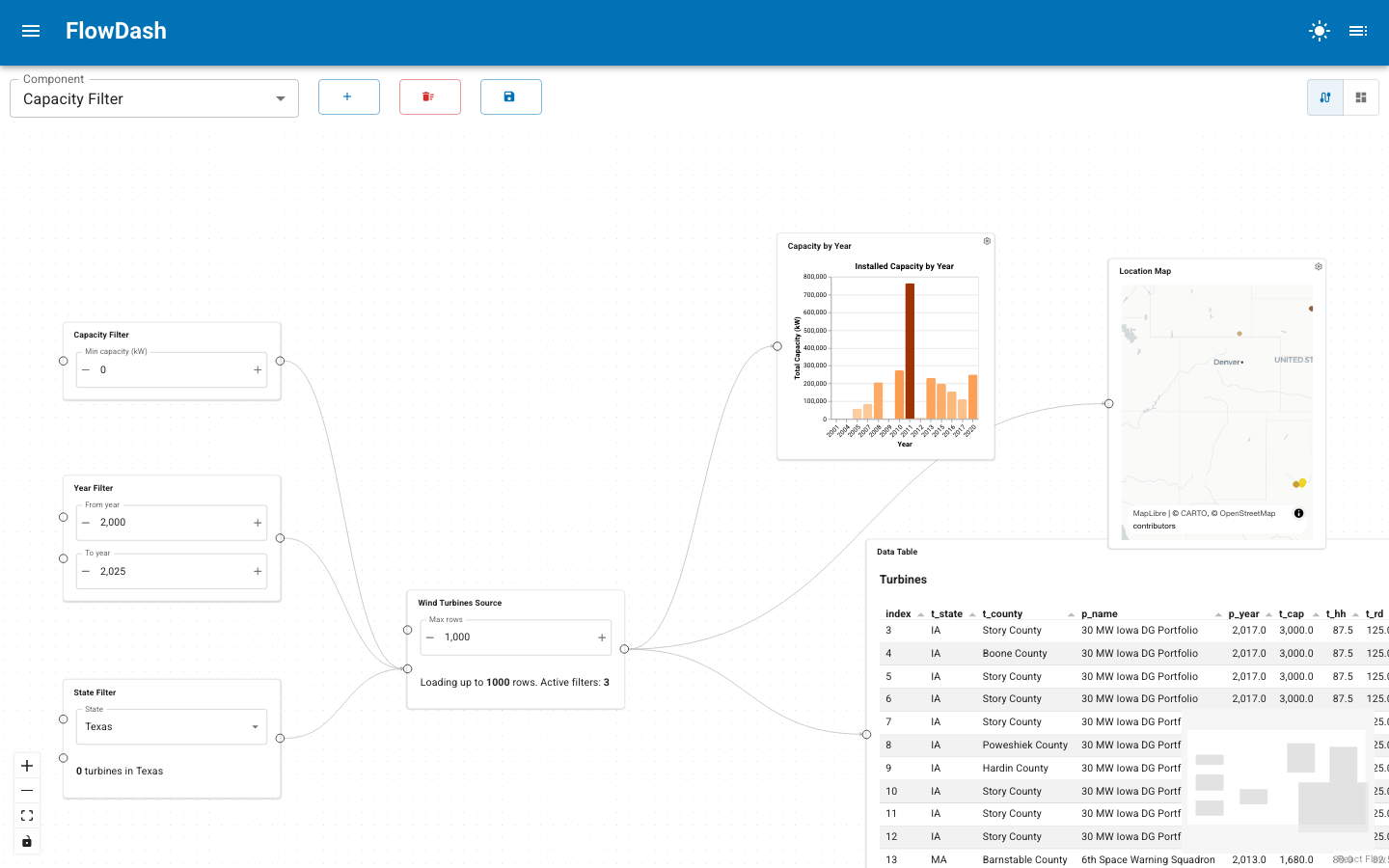
In the editor you build this graph visually: each component becomes a node whose ports are the handles on its left (inputs) and right (outputs), and dragging between handles creates an edge. The example below wires three sidebar filters into a data source that feeds a table, a chart, and a map.
Create a graph
from panel_flowdash import DataflowGraph, build_component_specs

specs = build_component_specs(registry)
graph = DataflowGraph(specs)
The on_error callback is invoked whenever a runtime value propagation fails:
def handle_error(source_id, source_port, target_id, target_port, exception):
    import panel as pn
    pn.state.notifications.error(
        f"Error: {source_port} -> {target_port}: {exception}"
    )

graph = DataflowGraph(specs, on_error=handle_error)
Add nodes
Each node is an instance of a component. The instance ID is unique on the dashboard; the component ID references the spec:
This creates a NodeState parameterized instance with one param per port.
Connect edges
add_edge returns True on success, or an error message string on failure.
Use this for user-facing notifications:
result = graph.add_edge(src_id, src_port, tgt_id, tgt_port)
if result is not True:
    pn.state.notifications.warning(result)
Validation rules
The engine enforces these rules before creating a connection:
Node and port existence
Both source and target nodes must exist, and the named ports must be present on their respective node states.
Single source per input
Each input port accepts at most one incoming connection. Attempting a second connection returns:
Input 'data' already has a connection. Disconnect it first.
Cycle detection
The engine uses BFS to verify that adding the edge would not create a cycle. Self-loops are rejected immediately.
Type compatibility
If both the source output and target input have declared types, they must match (case-insensitive). Untyped ports accept any connection.
Runtime validation
After an edge is wired, value changes propagate via param.watch. If the
target raises an exception on assignment (e.g. a param validation error), the
on_error callback fires rather than crashing the application:
errors = []

def collect_errors(*args):
    errors.append(args)

graph = DataflowGraph(specs, on_error=collect_errors)
graph.add_node("a", "comp_a")
graph.add_node("b", "comp_b")
graph.add_edge("a", "output", "b", "input")

# If setting b.input raises, on_error is called
state_a = graph.get_state("a")
state_a.output = "invalid_value"
Remove edges and nodes
Removing an edge unsubscribes the watcher and resets the target port to its default value.
Removing a node clears all connected edges automatically.