Trace and replay model calls
A session has two recordings. The Recorder writes what the user saw: messages, tool calls, artifacts and approvals as events, which load_state replays into the same components. The model trace writes what the model saw: pydantic-ai's own message history, one ModelMessage per line, with the model, tokens, cost, duration and tool calls of every request. It is what you continue a conversation from, and the place to look when you want to know why a turn was slow or expensive.
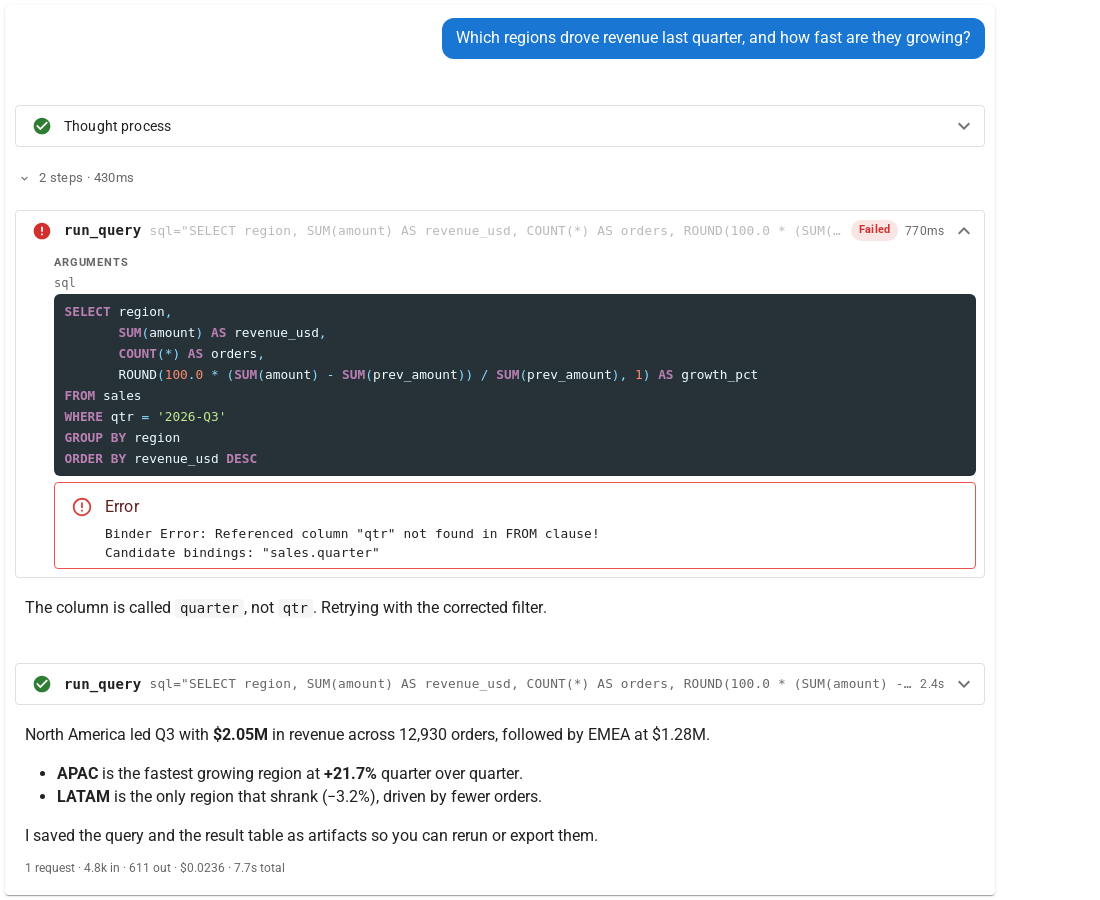
Record a model trace
Attach a ModelTraceRecorder to an AgentRunner:
from panel_agents.adapters.pydantic_ai import AgentRunner, ModelTraceRecorder

runner = AgentRunner(agent, state)
recorder = ModelTraceRecorder(runner, "runs/model-trace.jsonl")
The file starts with a format line, {"panel_agents_model_trace": 1, "include_content": true}, followed by the messages in the format of pydantic-ai's ModelMessagesTypeAdapter. The recorder brings the file up to date with the runner's history at the start of every model request, before the tools of a response run and when a run ends, so a response is on disk before the tools it called run. Further runs of the conversation append to the same file. close() detaches the recorder, and it also works as a context manager.
The trace records the persistent message history, the one AgentRunner.messages holds. Changes a capability makes only to the request it sends, without changing the history, are not in it. When the history is rewritten rather than extended, for example by a history processor that drops old messages, by runner.clear() or because a run failed, the recorder writes a {"rewind": n} record that keeps the first n messages, followed by the history from there on. The file therefore stays append-only, and loading it always gives the history the runner holds. The recorder notices a message that was replaced or removed, but not an older message object a capability changes in place; rewrite history by replacing messages, as history processors do.
Every response carries values that pydantic-ai does not record, under metadata["panel_agents"]: the wall-clock duration of the request in seconds, a fingerprint of the instructions and tools the model was offered and the request_id. AgentRunner also passes its run id to pydantic-ai, so the run_id on each message is the one on the events of the conversation recording. The ModelRequestStarted and Usage events of each request have the same request_id, and the Usage event the same duration.
Failed and retried requests
pydantic-ai lists attempts that failed before a later attempt succeeded, for example with a ModelFallback capability, on the response under failed_attempts. A run that fails outright, for example because the provider refused the request, leaves no response that joins the conversation. The trace records what the run sent, then a line naming the run, the error and the request that was in flight, then a rewind, since AgentRunner does not keep the messages of a failed run:
{"failed_run": "run-3f2a9c", "error": "ModelHTTPError: status_code: 429, ...", "request": {"model": "gpt-4.1", "timestamp": "...", "request_id": "...", "duration": 0.41}}
Retries that the provider's HTTP client makes on its own are invisible to pydantic-ai and so to the trace.
Summarize the model calls
load_model_calls returns one ModelRequestSummary per request, in order, including failed ones and responses a rewind later dropped from the history:
from panel_agents.adapters.pydantic_ai import load_model_calls

for call in load_model_calls("runs/model-trace.jsonl"):
    print(call.run_id, call.model, call.duration, call.input_tokens, call.output_tokens, call.cost_usd, call.tool_calls, call.error)
tool_calls lists the (tool_name, tool_call_id) of every tool the response called; the id matches the tool_call_id of the TOOL_CALL_* events in the conversation recording, and request_id the one on its ModelRequestStarted and Usage events. A response cut off by runner.cancel() has the error "Interrupted".
Show model calls of an older recording
Conversation recordings hold a ModelRequestStarted and a Usage event for each model request, which AgentChat and RunTrace show as model calls (see model calls and run traces). Recordings made before then have a bare Usage event per response, which shows the requests without the tool calls they issued, their request ids or the requests that failed. merge_model_calls adds them from the model trace of the same session:
from panel_agents import RunState, load_events
from panel_agents.adapters.pydantic_ai import load_model_calls, merge_model_calls

events = merge_model_calls(load_events("runs/events.jsonl"), load_model_calls("runs/model-trace.jsonl"))
state = RunState.from_events(events)
Each call is matched to its run by run_id and placed where AgentRunner emits it today: before the text and tool calls of its response, which the bare Usage events of the recording mark, or, without them, the tool_call_ids of the calls it issued. Failed attempts that a retry recovered from are attached to their request, as they are live. The bare Usage events a call takes the place of are replaced, so the totals of a run are not counted twice. Runs the recording does not hold are left out, and so are runs it already holds ModelRequestStarted events for, so merging into a recording made since model calls are recorded changes nothing. The result is a list of events like any other: record it with dump_events to keep the merged session. To show it in a chat that is already open, state.reset() and state.apply_many(events).
Continue a conversation
load_messages returns the history as pydantic-ai messages, as the runner held it when the trace ended. Assign it to a runner and the next run continues the conversation; a recorder attached to the same file appends to it:
from panel_agents.adapters.pydantic_ai import load_messages

runner = AgentRunner(agent, state)
runner.messages = load_messages("runs/model-trace.jsonl")
recorder = ModelTraceRecorder(runner, "runs/model-trace.jsonl")
await runner.run("And for last year?")
The chat shows only the new run unless you also replay the conversation recording into state. A recorder writes the history the runner already has when it is attached: all of it to a new file, and only what differs from the conversation an existing file ends with. A resumed conversation can therefore be recorded to a new file and still be complete, and a recorder attached in the middle of a run records the whole history.
AgentRunner passes the id of each run to pydantic-ai. Pass run_id to run() to choose it; run_kwargs cannot hold one, since every run needs its own.
Store recordings in your own database
Both recorders write to a sink. Besides a file path, a sink can be a text stream or a plain (not async) callable, which receives a copy of each record as the JSON-ready dict a line of the file would hold: the format record first, then one record per event or message, rewind and failed_run record. Redaction is applied before the callable sees anything. The loaders accept any iterable of those dicts in the order they were written, so a host can keep sessions next to its own data:
def store(record):
    db.execute("INSERT INTO model_trace (session, record) VALUES (?, ?)", (session_id, json.dumps(record)))

ModelTraceRecorder(runner, store)
Recorder(state, lambda record: db.execute("INSERT INTO events (session, record) VALUES (?, ?)", (session_id, json.dumps(record))))

rows = db.execute("SELECT record FROM model_trace WHERE session = ? ORDER BY rowid", (session_id,))
runner.messages = load_messages(json.loads(row[0]) for row in rows)
A callable cannot be asked what it already holds, so a model trace recorder writing to one, or to a stream, starts with a format record and a {"rewind": 0} record every time it is attached, then writes the runner's full history. The loaders read repeated format records and apply the rewinds, so the result is the history the runner holds, whatever the store held before.
The callable runs synchronously on the event loop, inside the agent run. A store that takes noticeable time should hand the records to a queue or a thread, or the app stops responding while it writes.
A sink that raises does not end the agent run: the error is logged with its traceback on the panel_agents.recording logger and that record is lost. A model trace recorder then forgets what it wrote, and at the next sync the sink accepts it writes {"rewind": 0} and the full history again, so the store heals itself. Pass on_error="raise" to either recorder to let sink errors propagate into the run instead.
Once a Recorder keeps the events, a long chat session does not need to keep them in memory too: RunState(max_events=1000) keeps only the latest, since every streamed delta is an event. Load the recording, not state.events, to replay such a session.
A crash in the middle of writing a file can leave its last line incomplete. The loaders ignore such a line, and a recorder attached to the file drops it before appending.
Leave out the content
The model trace is the most sensitive recording: it holds every prompt, the instructions, tool arguments and results, and anything the agent put in its context. Record without them when you only need usage and timing:
Messages then keep every part with its kind, tool name, tool call id and outcome, and their usage, timestamps and duration, but prompts, instructions, text, thinking, tool arguments and results are emptied, file data is removed, and errors are reduced to the exception type. Such a trace still loads and summarizes, but it cannot continue a conversation. A file keeps the setting it was started with; recording to it with the other setting raises ValueError.
Artifacts published by tools are never written to the model trace, since the model does not see them; the conversation recording keeps them.
Play a trace back
A Cassette is a pydantic-ai model that answers each request with the next recorded response. The agent loop, the tools, the approvals and the UI run for real, but no provider is called, so a recorded session becomes a test that runs offline and costs nothing:
from panel_agents.adapters.pydantic_ai import AgentRunner, Cassette

cassette = Cassette.from_trace("tests/cassettes/east-sales.jsonl")
runner = AgentRunner(agent, state, run_kwargs={"model": cassette})
await runner.run("How much did east sell?")

assert cassette.divergences == []
assert cassette.remaining == 0
Cassette.from_trace replays every model call the trace recorded, once each and in the order they were made, each with its response as first written and compared with the requests as first sent. That holds for an agent that rewrote its history, for example with a history processor that shortens old tool results, rewrites old responses or keeps only the last messages, and after runner.clear(). A request that failed raises RecordedFailure with the recorded error, prefixed with its exception type as the trace holds it ("RuntimeError: provider refused"), where playback reaches it, so the run fails as it did; it is not a CassetteError. A tool that raised does so again on its own. A response cut off by a cancellation is played like any other. Traces written before responses carried a request id are played as the history they end with.
Cassette(messages) takes a message history directly, for example result.all_messages(), and compares against the messages as given. Both work with agent.run, agent.override(model=cassette) and streamed runs alike. The responses keep their recorded parts, model name and usage, so the chat shows the same usage as the recorded run, but take the run id of the playback, so a trace recorded during playback joins with its own events.
A cassette holds the model fixed and tests everything else. Each tool result, user prompt and output validator retry the agent sends at a request is compared with the recording, and every difference is collected in cassette.divergences as a Divergence naming the request, the tool call and the recorded and actual values; with strict=True the first one raises CassetteError instead. Playback fails with CassetteError when a recorded response calls a tool the agent no longer offers and when the agent makes more requests than were recorded. What a history processor does to older messages is not compared, so a changed processor is not reported.
A cassette also goes stale when the instructions or tools change, even if every result still matches. AgentRunner stores a fingerprint of the instructions, system prompts and tool schemas on each response, and the cassette raises CassetteError when the agent it plays to offers something else. Record the cassette again after such a change. For an agent whose instructions change from run to run, for example because they include the date, pass check_fingerprint=False; a mismatch is then reported as a divergence of kind "fingerprint".
Playback executes the agent's tools, so treat a cassette from someone else like any agent run: it runs under your approval policy and your tools' permissions. A trace recorded with include_content=False cannot be played back.